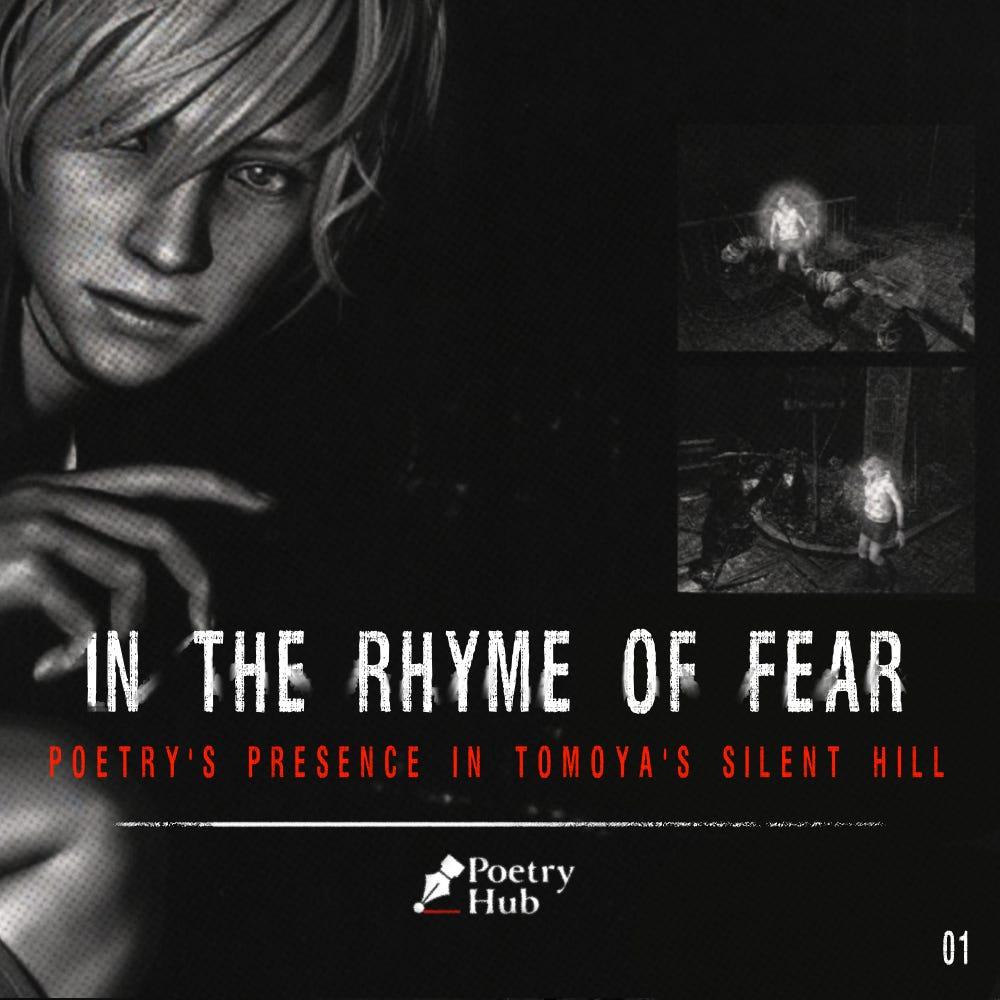
In The Rhyme of Fear: Poetry's Presence in Toyama's Silent Hill
PoetryHub · August 3, 2024
Within the genre of horror, there's a close link to psychology, specifically in the mysterious and unfamiliar aspects of our minds.
Video games provide a direct seat in exploring the ongoing terror, as we become part of the story and influence it interchangeably.
Toyama’s Silent Hill rose to the psychological horror genre during the late 90s,
His intention was to create a game that is less scary in the traditional framework, and focuses more on introspective and contemplative functions to inspire fear.
Silent Hill aims to construct a symbolic and haunting atmosphere within the city. The game serves as a reflection of the real world through the lens of the conscious and the unconscious mind, in addition to establishing two distinct realms that sharply contrast each other.
One world is an unsettling and dreamlike ghost town, while the other is an industrial landscape tainted by rust. This duality adds depth to the narrative, creating an eerie and thought-provoking experience for players.
As Above So Below and Willaim Blake’s Marriage of Heaven and Hell.
In Silent Hill, the player—through the protagonist Harry Mason—delves into a virtual
Hell to experience a simulated environment of the unconscious
The concept of duality is a central theme, reminiscent of the English poet William Blake's exploration of contrasting experiences in his work, "Songs of Innocence and Experience." Blake's journey through Hell toward enlightenment aligns with his depiction of two perspectives: one of a young, innocent child perceiving the world as full of excitement and hope, and the other of a mature man troubled by the injustices and horrors within societies and communities. This duality in perception adds a layer of complexity to the narrative, paralleling the psychological intricacies explored in Silent Hill.
This dichotomy of the two worlds echoes the Hermetic aphorism "As above, so below," which suggests that our inner states profoundly influence our external circumstances, and vice versa. In other words, the game reflects the idea that our psychological state plays a fundamental role in shaping our realities.
In the context of Silent Hill, the transition between the "Good" and "Evil" worlds reflects this complex interplay of opposing psychological states, crafting an engaging and immersive experience for players.
Slide 6: Poetic Puzzles and Solving the Mystery.
One way of uncloaking the veil lies in poetry. Silent Hill is prevalent with poetic references, aiding in exploring the subconscious dimension of the town, and in return helps the player participate in its worldbuilding. It allows for agency over ‘the narration of fear’ as the player interprets their meaning and reaches a realization that emanates from beyond the fog.
Shakespeare Anthology Puzzle, Silent Hill 3
A puzzle at the start of the game, requires the player to have sufficient background on
5 Shakesperan plays, (Hamlet - Romeo & Juliet - Macbeth - Othello - King Lear)
The anthologies are highlighted by falling off the shelf, and accompanied by a piece of paper that starts with the following lines:
"In here is a tragedy---
art thou player or audience?
Be as it may, the end doth remain:
all go on only toward death.
The player must find a four-digit code to input into a keypad on the door behind the counter.
The puzzle, therefore, requires engaging in introspection by exploring the environment and immersing themselves in the eerie atmosphere.
Is it a game or a mirror held to our own convoluted life?
The underlying theme, expressed through the question “Art thou player or audience?” introduces the concept of Appearance vs Reality, a prominent Shakespearean device.)
Here, it hints at a deeper truth behind the puzzle, and thus, the game. We are not the mere audience of Silent Hill as it may seem, but are actively unveiling a cloak of psychological fog that mirrors our own fears.
References to Shakespeare’s tragic dramas throughout the poem parallel the outline for the plot of Silent Hill: a story about ‘suffering’, ‘vengeance’, ‘ill-fate’, ‘betrayal’, ‘greed’, and ‘possessive’ and ‘obsessive’ behaviors.
Doth lie invite truth?
Doth verity but wear the
mask of falsehood?
Ah, thou pitiful, thou
miserable ones!
The following verse hints at Macbeth, to solve the puzzle, this verse must be omitted to produce the required 4-digit number.
Why Omit Macbeth and Conclusions
Macbeth is a story of deceit and betrayal, omitting it presents a level of intrigue that reconsiders the appearance vs reality theme.
Through inviting truth – “Doth lie invite truth” – the poem seems to suggest that the veil between facades and reality is paper thin. Directing our attention towards our perception of the outside world as a reflection of us, and not an objective solid truth.
In other words, the philosophy of the subconscious in Silent Hill regarding the two worlds: ‘Above’ and ‘Below’, or the ‘foggy town’ and ‘rusting industrial clanking of metal’ can be interpreted as the contrasting worlds being equally real and in direct relation to the protagonist’s journey.
References:
Soafala-Jones, Eric. The Marriage of Heaven and Silent Hill: Exploring the Occult Psychology of William Blake within A Virtual Hell. Georgia College & State University. 2021.