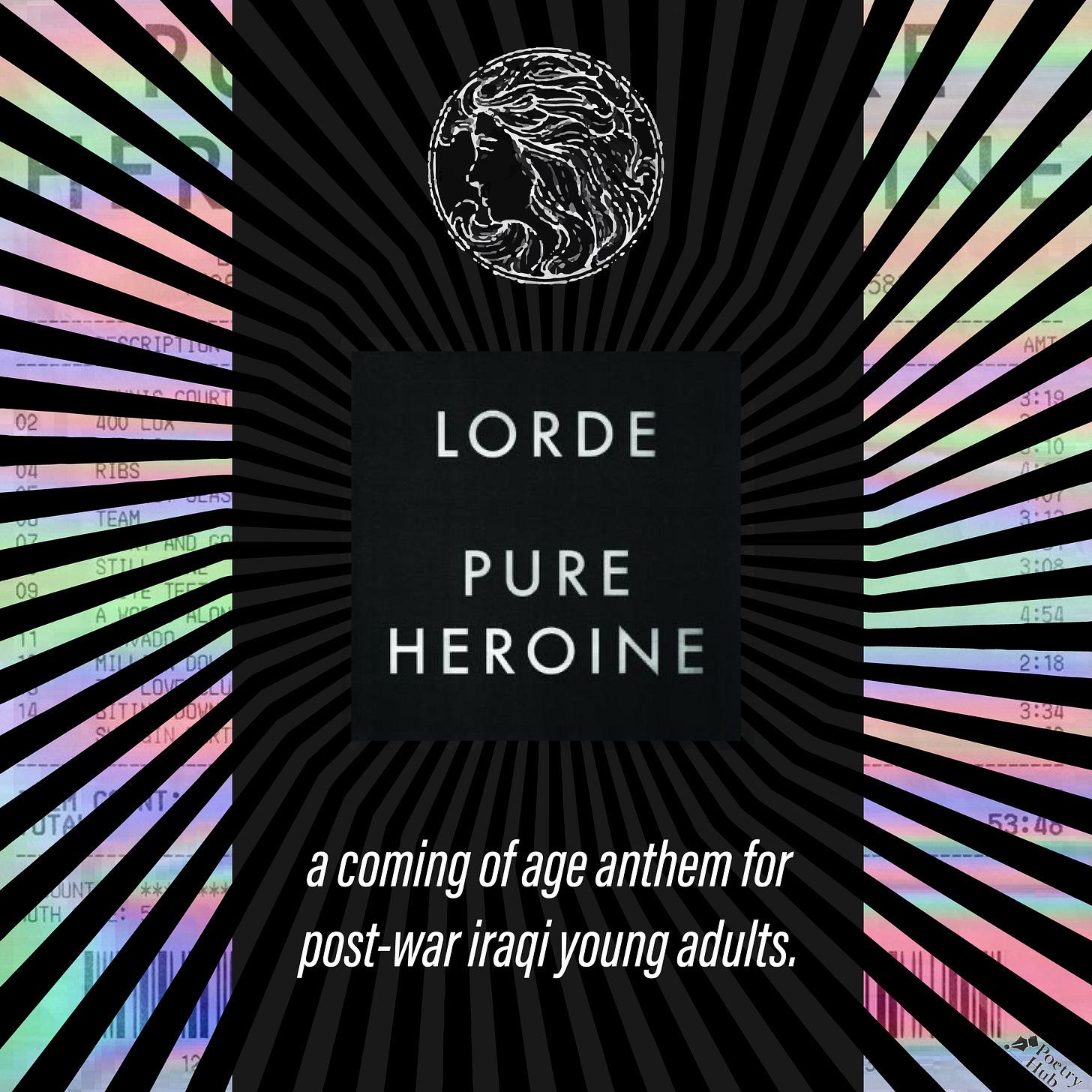
Pure Heroine: a coming-of-age anthem for post-war Iraqi young adults.
PoetryHub · August 3, 2024
Through the prevalent references to unattained luxury, the theme of poverty seems to permeate the album, echoed by ensnaring lines like “I live in a hologram with you” or hidden within favorite quotable insignias: “Baby be the class clown/I’ll be the beauty queen in tears.” Providing to us another impoverished sensation, of lack of human connection and human experience.
To live in a hologram with someone, a demonstration of imagined experiences, growing into a young adult in a war-ridden country leaves no space to eviscerate the internal feelings into a worldly ring, but forces us to cling to a phantom, a what-could-have-been if we didn’t have to look behind our shoulders every time we sneaked to live our lives. Similarly, a disdain for the celebrated is expressed, a resentment for the ones who are loud and proud “the class clown,” while the oppressed lamenters have to hide and stash away their substantial beauty in fear.
Concrete imagery fits well with walled-up houses and long-distance friendships, “I am glad we stopped kissing the tar” Is it the relief of sharing the calamity of our aggression or are we done with the wishful thinking? Lux 400 dives into visceral questions, of being and non-being, a Platonic upheaval in the catastrophe of our teenhood. This laundromat of un-answered yearnings is continued onto the following tracks, “we can talk it so good/ we can make it so divine” and “I want them back/the minds we had/ how all the thoughts/ moved around our heads.” The epileptic visions of early childhood soon swept out of sight and into the attic of our newly formed bodies. Lastly, regardless of all the deficiencies of a space, “We might be hollow, but we're brave” It is rather valiant to exist within this space, and many of us who struggled to fit in it did it so bravely.
“Explosions on TV/ and all the girls with their heads inside a dream/now we live beside the pool/ where everything is good.”
In fear, twinkles of happiness shine through, I remember once during Eid driving around with my family, I saw each girl and boy dressed to the nines as if days ago a huge explosion didn’t kill hundred of them, because they are used to it, the fear is part of the Iraqi spirit, it emphasizes being alive: “We’re so happy/ even if we are smiling out of fear.” This “Hot-Sweet” irony delivers scraps of assimilation into post-war Iraq time, there is a certain acceptance, an alchemical romance with the terror, the world may have burnt our heads to crisps, but “It’s buzzcut season anyway.” Iraqis have learned to romance fear, and pursue it as a domesticated animal, accustomed to the desert we had to re-envision it into a Van Gogh on daily basis: “We live in cities you'll never see on-screen/Not very pretty, but we sure know how to run things”.
Perhaps the absence of lived experience is restricted to the “teenage dream”, as there is no shortage of the experience that comes from pain and loss. The early adolescence spent leaving school grounds, not to the mall but feeling from a near bomb, imbuing a sense of survival that made it hard to take anything else seriously. You can try to take us but... “victory is contagious” and “chance is the only game” played, surviving an accumulation of death builds a strong resilience in the heart, however: “It’s alright if you think about death, It’s fine”.
The lost youth anthem, “Ribs,” circulates this much-needed escapism, a serenade to a childhood that seems ancient and much removed from us. “This dream isn’t feeling sweet/and I’ve never felt more alone,” regretting the snowglobe of maturing as soon as entered. Growing old is a scary risk, to finally understand all the tragedy, to finally sense the loss and yearn for the -what-should-have-been.
Movies and TV were one of the ways to escape the war-melted culture, it functioned as a third eye to the world, as it was difficult to keep up with the modernity of the first world. Movies were open books to gain second-hand experiences about different cultures and expand knowledge about public relationships and freedom that were not granted in reality. Cinema made us see new colors that reflected our true, untapped identity.
There is heavy alienation that ties all the aforementioned motifs together, perhaps most done eloquently in the final track, “A World Alone,” which tapes together sensations of being impoverished, outcasted, of almost giving up but hanging on by a thread–a window view onlooking the haphazard society: “All my fake friends and all of their noise, complain about work/They're studying business, I study the floor,” referencing the “White Teeth Teens” in the previous track, who can easily be the westerners we copied from TV, or the people adjacent to us living much better than we do, we tried to “join” to become the “likeness set in stone,” but alas, “The way they are, the way they seem is something else, it's in the blood”, and so we are settled into the floor, projecting to it all the lives we should have lived.
Almost definitely, another need to escape was the humiliation that came with admitting our address: “And I’m not proud of my address, In a torn-up town, no postcode envy” The standards of living set by social media sites have made it difficult for a person to reveal their address. It has been painted as a torn, unsafe country with a weak economy, which has made it difficult for especially growing youngsters to reveal where they’re from without feeling uncomfortable or ashamed.
Killing time and its importance for the alienated escapist: “We are never done with killing time,” echoes the early depression of filling the mind and the gaps of presence; during war and its aftermath, where do teenagers go? They are a marginalized community, they have to learn to create their own “hologram”, i.e., their own world. Contemporary Slovenian psychoanalyst Slavoj Zizek mentions in his interviews that the internet persona could be the real hidden self that is freely expressed in safe anonymity, and in the context of being raised by the internet, using it as a Third Place. For Iraqi young adults suffering from fragmented identity, this is very accurate. “We wouldn’t be seen here in the day” The anonymous and freeing internet help us be “Still Sane.” The limited access to opportunity also leads us to glorify tidbits of moments: “You buy me orange juice.”
“But in all chaos, there is calculation”
The electronic, dreamy production, the lyrical hidden meanings, wild metaphors and delicate words, the dreamy snares, the catchy basslines, and the simple beats of “Joel Little” with Lorde’s solid vocals, translated into a shared feeling of alienation. The nostalgic and fluorescent atmosphere permeating the 10 tracks invites you into a filmstrip daydream, of childhood visions and slow thoughts tangled between.